And 100 Kids Prayed

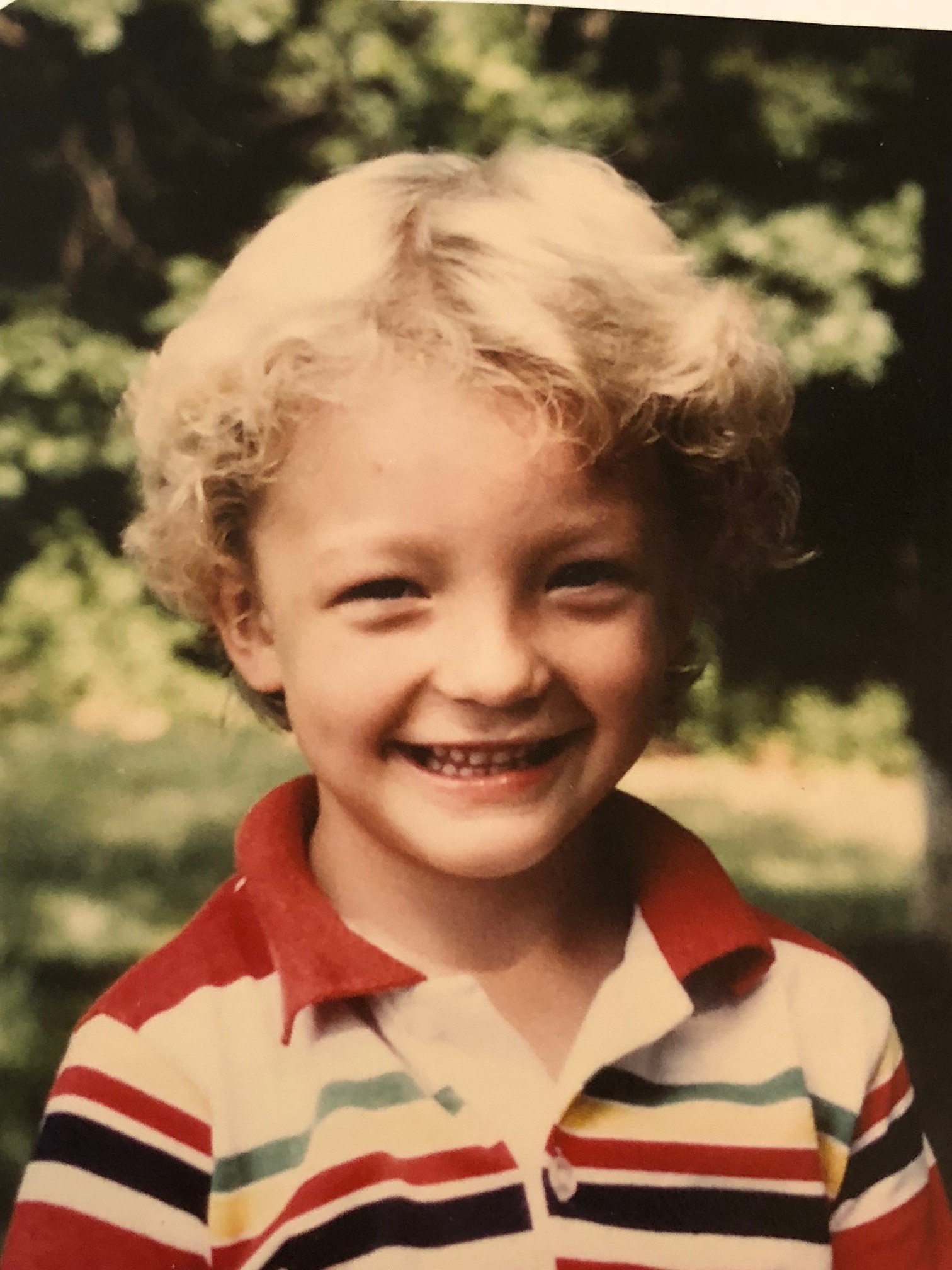
August 15, 1983. I was 21 years old and a junior at the University of Missouri-Rolla. I was also a children’s pastor at my local church. I left my apartment that evening to preach at a children’s event in Dixon, Missouri. Over 100 children ages 3 to 12 were gathered from local churches for the service. As I walked out to my car, my landlady burst out her front door and rushed to her car. “Jesse has been run over by a garbage truck!” she cried out. “Please pray!!” Jesse was her 4-year-old grandson and one of the kids in our children’s church. I was torn. “Should I cancel the engagement and head to the hospital or go to Dixon and preach?” I decided to head to Dixon.

Prior to preaching to the kids, I called the hospital. Jesse was critically injured. A 12-ton truck had crushed his left shoulder, left rib cage, pelvis and abdomen, nearly severing his left leg. His blood pressure was 30/0. Blood was transfusing. He was headed to the OR. It seemed awfully bleak. To be honest, my faith was low.  I didn’t think he’d make it.

I proceeded to preach to the 100+ kids about Peter, contrasting his cowardice before Jesus’ crucifixion with his boldness after Pentecost. I dressed as a surgeon in blue scrubs, gown and mask for the sermon. During the sermon, I took a boy and proceeded to “surgically” remove a live chicken from his belly while talking about Peter and how the Holy Spirit “got the chicken out” of him. It was just a simple object lesson. 

The sermon went well. Children were rapt with attention and they did not harm my chicken when I let her loose in the church. But my thoughts were elsewhere. After finishing the sermon, I pulled a 4-year-old boy out of a pew. I explained to the kids:

“I’m not a real doctor. This was a pretend surgery illustrating a spiritual lesson. But at this very moment there are real doctors dressed just like me, operating on a real little boy just this big [pointing to the 4-year-old standing with me]. This little guy has been crushed by a big truck. Satan wants to kill him, but we need to pray and pray really hard.”

The church was absolutely silent. No child stirred. I turned the service over to one of the other ministers and immediately left for the hospital. As I left, I saw the kids begin to kneel and pray.

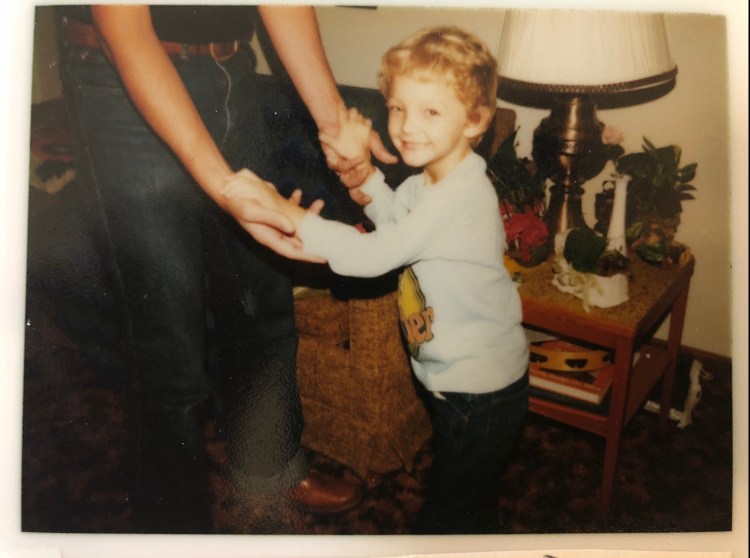
A miracle happened that day. Jesse lived. His leg was saved. Recovery was expected to take several months and was likely to cause significant disability. But he was riding his bicycle within a few months. No disability at all.

Tragically, a year later, Jesse’s father died unexpectedly. Several months after that, I married Jesse’s mother, Diana. Jesse’s children’s pastor had become his step-father.

In the summer of 1989, I had been accepted to medical school on an Air Force scholarship. I went to Texas for six weeks of officer training. While there, the 700 Club heard of Jesse’s miracle and flew Diana and Jesse to Virginia Beach to appear on the show. After their appearance, they were invited to appear on another Christian talk show in Chicago. They scheduled the appearance after my officer training so I could appear with them. We drove to Chicago for the taping of the TV show. During the interview, I told them about the kids in Dixon. Walking off the set, the next guest grabbed me by the arm as she stepped up. “I have to talk to you,” she whispered, “Please don’t leave!!”

After her interview, she approached us.

“You don’t remember me, do you?”

“No,” I replied.

“I was the minister you left all those kids with in Dixon, Missouri,” she informed me.

I apologized. “Oh! I’m so sorry!”

“No worries!” she replied. “You don’t know the rest of the story. After you left, those 100 kids prayed. Even the little ones. And they prayed for well over an hour. Unprompted. Un-coached. Without additional encouragement or adult direction. It was one of the most amazing things I’ve ever seen. Those kids prayed like they meant it!”

I believe those kids’ prayers had a lot to do with Jesse’s miracle. I’m so thankful for God’s mercy and faithfulness and the obedience of those children.

Eventually everyone will experience really tough times. That is life. When bad things happen and you’re asked to pray for someone, pray really hard.

Pray like you really mean it.

Pray like a kid.
 

IMG_1021
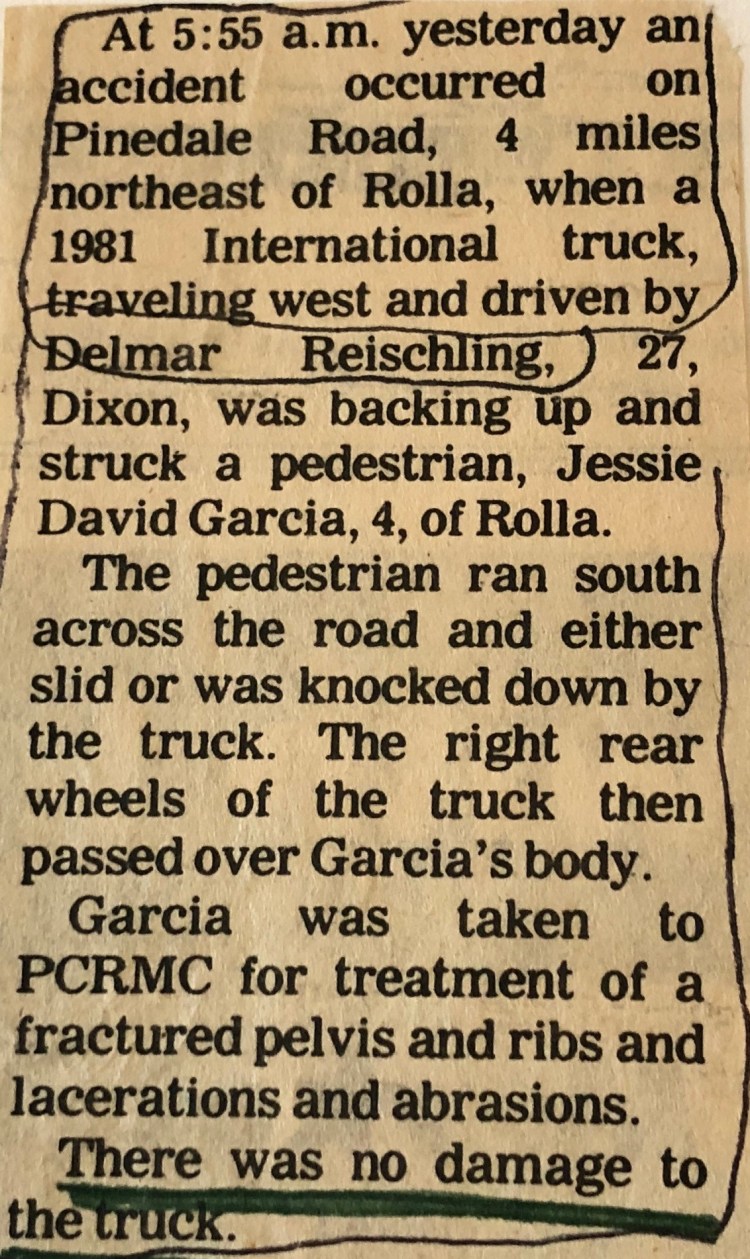
News article from the Rolla Daily News the day after the accident (August 16, 1983). The time quoted (5:55 a.m.) was incorrect. It was 5:55 p.m. Note the truck was not damaged.
IMG_1019
Jesse learning to walk again after the accident
IMG_1023
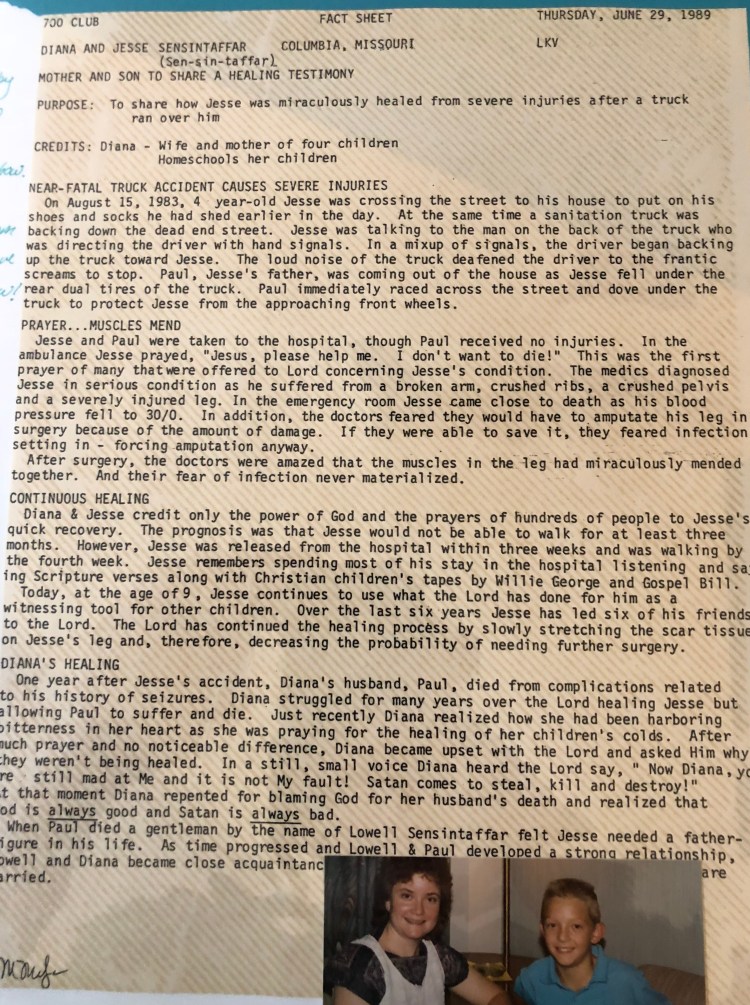
Fact sheet from the 700 Club. June 29. 1989
IMG_1024
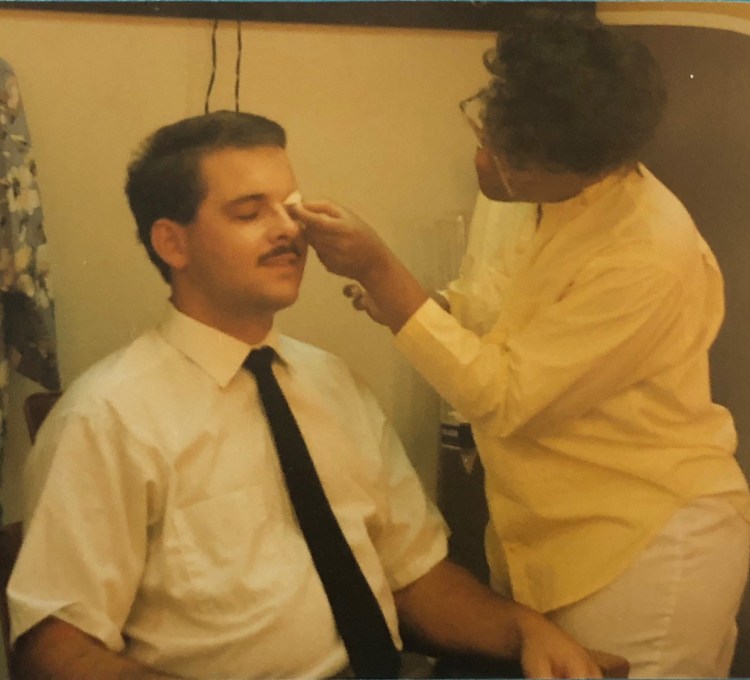
Me “in make-up” prior to the 1989 Chicago interview. July 18, 1989

A Sauna Surprise

Malta, 2000.

Diana and I were celebrating our 15th wedding anniversary in Malta. We were staying at the very luxurious Hilton in the St. Julian’s district of Valletta, the capital city. We were enjoying the seaside “endless” pools overlooking the Mediterranean and having a delightful time. I left Diana relaxing in the pool and went over to the sauna that was right at the poolside. I opened the door to the sauna, walked down to the opposite end and had a seat next to the steaming rocks. 5 minutes is usually about my limit. About 3 minutes into my Maltese sauna experience, a young woman walked into the sauna, wrapped in a large white towel. She took off the towel, politely folding it for a seat cushion, and sat down next to me. She did not have a single stitch on. Totally naked. She was from Austria and in Malta on holiday.

“This is not a good situation,” I pondered nearly audibly. “Probably a good time for me to leave.”

I started to stand up to leave and at that very moment Diana called out for me. She was right at the door of the sauna!  Panicking, I took stock of the situation. I reasoned if I acknowledged her call, she’d likely open the door and step into the sauna to join me and then she’d see the situation I was in. So I sat back down and did not say a thing.

Mercifully, I heard the pitter-patter of feet as Diana walked off, muttering, “Hmmm, I guess he’s in the locker room.” So, I sat there a little longer for what seemed like an eternity, certainly exceeding my 5 minute limit. Sweat poured off my body. Uncomfortable in so many ways. When what seemed a suitable amount of time had passed, I excused myself from my self-imposed hell, and stepped out of the sauna, looking to the left and right for Diana. The coast was clear. I went to the men’s locker room to shower and cool off. The sauna was exceptionally hot, after all.

I joined Diana in the pool a little later.

“Were you in the locker room?” Diana asked.

“As a matter of fact, I was,” was the technically truthful answer.

Praise, Profanity and a Cigarette

He was the short, greasy little guy who lived upstairs from me when I was a junior at the University of Missouri–Rolla. It was 1984. He chain-smoked and chain-cussed. He smelled of body odor, stale tobacco, and cheap cologne. He had shoulder-length greasy black hair, a pockmarked, acne-scarred face, and a smudge across his upper lip that may have seen the business end of a razor once a month—if that.

He was a gross little guy in a likable sort of way.

He was my friend.

So I invited him to church.

He’d never darkened the door of a church—not once. He had barely heard of the Gospel. After several invitations, he agreed to join me.

We walked into the packed little church one evening and found a couple of seats on the front row. My greasy little friend just sat there, taking it all in. He didn’t say a word. He didn’t sing. He showed no visible emotion.

Halfway through the song service, he reached into his backpack and pulled out a glass bottle of Coke. Twisting off the cap with a loud pfffsssttt, he took a long sip.

“Okay,” I thought. “Not too big a gaffe. We can talk about it later.”

But then…

When he finished his Coke, he reached into his shirt pocket, pulled out a pack of Marlboros, lit one up, and began puffing away—politely dropping the ashes into his empty Coke bottle—all while dutifully listening to the pastor’s sermon.

The pastor looked at my friend, smiled broadly, and kept right on preaching.

Thin little smoke rings floated lazily over the altar.

I was mortified.

I don’t think I heard another word the pastor said.

After what felt like an eternity, the pastor gave an impassioned altar call. To my amazement, my friend went forward and gave his heart to God. Tears streamed down his face as he prayed a prayer of salvation.

Then, in gratitude, he lifted his hands and proclaimed loudly:

“Thank you, Jesus! Thank you, Jesus! You’re so f#$&#ng wonderful!”

And then he said it again—just as loudly. Just as passionately.

The pastor hugged him.

A few little old ladies hugged his stinky little neck.

As for me? I stood there, dumbfounded.

I wish I could say I rejoiced with him in that moment.

I didn’t.

I was embarrassed—more concerned with how his words and actions reflected on me than with what had just happened.

It wasn’t until the next day, after reflecting on the whole experience, that I understood what I had witnessed. Beneath the veneer of my friend’s uncouth persona was a heart reborn—a new creature expressing himself in the only way he knew how.

The pastor rejoiced with him.

Those little old ladies rejoiced with him.

I’m certain the angels in heaven rejoiced as well.

His praise was uncouth, uncensored, and raw—but it was absolutely sincere.

It was perfect praise.

And God loved it.

I am sure of that.

Zoe and Dad Mountain

Spring 1998.

We were winding our way up the mountain that loomed over Aviano, Italy. From the back seat came a small, inquisitive voice. Zoe, age six, had a question.

“Dad, what’s this mountain called?”

“They call it Monte Cavallo. And the town at the base of the mountain is Piancavallo. That’s where we’re going.”

“Why do they name mountains?”

“I don’t know, Zoe. I suppose they name mountains simply because they’re there.”

“Oh…”

A pause.

Then another question.

“What’s the name of that mountain?” she asked, pointing to a small hill just to the right of the road.

“I’m not sure it has a name.”

“Why?”

“People don’t usually name hills, Zoe. They’re too little.”

She thought about this for a moment.

“Why? I’m little—and I have a name.”

She had a point.

I pulled the car over.

“Zoe, do you like that mountain?” I asked, pointing to the hill.

“Yes.”

“Would you like to climb it?”

“YES!”

We climbed out of the car and scampered up the “mountain.” When we reached the top, Zoe turned to me, beaming.

“Dad, I like this mountain a whole lot.”

“I’m glad you do, Zoe. Would you like to name it?”

“Yes! I name this mountain Zoe and Dad Mountain!”

She proclaimed it—and so it was.

You won’t find it on a map.

But it’s there.

And it is our mountain.


The picture above was taken on the summit of Zoe and Dad Mountain to commemorate the event.

Bernard and Me

Spring, 1988.  I was a graduate counseling student at CBN University (now Regent University), a Christian graduate school in Virginia Beach, VA.  I was taking the entry-level counseling class and our capstone project was to find a person to counsel and video-tape the weekly 50-min counseling sessions.

Most students found friends and family members to “counsel.”  I went down to the an inner-city ministry in the Tidewater housing projects in Norfolk, Virginia and asked if they had anyone in mind. They suggested Bernard, a black man about 15 years my senior who suffered just about every scourge an inner-city man could suffer . . . drug and alcohol addiction, chronic unemployment, estranged family, multiple children by multiple women, abuse, problems with the law. He had the whole enchilada. He wanted help getting his life on track.

Every Tuesday evening, on the campus at CBN, Bernard and I would meet in a little room with 2 chairs, a table, and a video camera mounted in the corner. I would pop a VHS cassette in, press record, and we would talk. That next Thursday, Dr. Jean Orr, our professor, would randomly select a video from among the class members to view and discuss in our counseling lab.

One Tuesday evening, Bernard and I were discussing his responsibility to be a father to his children regardless of the status of the relationship with the mother. I wasn’t getting anywhere with him.Things were getting tense. Bernard was evasive, conjuring up every excuse in the book to justify not staying involved with this children.

“I can’t reach out to my kids! I don’t even know where they live!” he appealed.

I was becoming irritated. “Bernard, have you tried calling their mother and ask to speak to your children?”

“I don’t now her phone number!” countered Bernard.

That was the last straw. I was tired of the excuses. In frustration, I grabbed the telephone off the table between us, stood up, and literally threw the phone at him, striking him in the chest, causing him to stumbling out of his chair and fall to the floor. “Damn it, Bernard,” I screamed, “call 411 for information!!!” Shocked and bewildered, he picked up the phone off the floor, dialed 411 for the operator and was able to get his ex-girlfriend’s phone number. He called his girlfriend right there and was able to set up a time to visit his kids.

That next Thursday, Dr. Orr randomly selected my video. I thought, “Oh man! There goes my grade. I’ll flunk for sure.” The video played without significant comment until the part where I verbally and physically attacked my client in a most unholy manner. Gasps echoed throughout the class. The professor paused the video, closed her eyes for seemed like an eternity, and finally turned to me.

She was somber. “I appreciate that you have verbally and physically illustrated the frustration we all feel from time to time while counseling our clients.” And then she spent the next hour talking about appropriate boundaries, frustration, and professionalism. It was a very long hour.

Suddenly, Dr. Orr glances at her watch. “Ooops! It looks like we’re almost out of time!  Let’s fast-forward the tape to the end of Mr. Sensintaffar’s session and see how he wrapped things up.”

Just so happened, the VHS tape was a used tape I pulled from the TV cabinet. It had been used to tape movies off the TV. Inadvertently, Dr. Orr fast-forwarded the tape past the end of the counseling session and right into a taped version of the new hit movie, Lethal Weapon. She pressed the play button at the precise point Mel Gibson body slams Danny Glover and holds him at gunpoint. The class erupted in laughter. I shrunk down into my seat. I was mortified.

It was legendary, I’m told.

I did get an “A” for the class.

Two Dozen Roses Plus One

January 1988

I’d just received word doctors would be ready to discharge Diana and Hannah later that afternoon. The birth of my first daughter, two days prior, was certainly something to celebrate! I put on a coat and tie and I went down to the local florist before going to the hospital.

“I’d like two bouquets of a dozen long-stem red roses,” I asked the florist. (A dozen for Diana and a dozen for Hannah).

“OK, that will be $63.58, with tax,” replied the florist.

Taking a mental note of my bank account, I quickly reversed myself.

“Oh, never mind.” Sixty-four dollars might as well have been a thousand back then. Too expensive and we had rent and utilities to pay in just a week. So I considered other options.

Thumbing through the phone book at the florist shop, I saw a promising entry–a floral wholesaler in downtown Norfolk. And it wasn’t too far out of my way to Norfolk Sentara Hospital where Diana and Hannah were hospitalized. These were the folks who supplied the retail florists. So, with just a few hours before I was supposed to pick up Diana and Hannah, I headed downtown en route to the hospital.

I pulled up to the warehouse in a sketchy part of downtown Norfolk. I wandered in, coat, tie, and all. There was no retail presence at all in the warehouse. Just crates of flowers and a few forklifts.

“Ah, excuse me sir. May I help you?” inquired the guy in coveralls.

Getting right to the point, “Yes! I’d like to buy two dozen red roses.”

The guy seemed perplexed. “We don’t sell roses like that. Are you a florist?”

“No sir, I just want to buy some flowers,” I implored.

“So, you’re not a florist and you don’t have a business account with us?”

“No sir,” I replied. “Just here for two dozen roses.”

“Let me see what I can do.” The guy seemed amenable to helping me.

A few minutes later he comes out with an armload of red roses.

“Sir, we sell roses in bundles of 25. $15 per bundle.”

“Perfect!” That was right in my price range. I handed him the cash, I had my roses, and the man in coveralls turned to leave.

“Um, excuse me sir. Do you have any Baby’s Breath and fern greenery?” I asked hopefully.

The man in coveralls quickly spun around. “What?”

“Yes, I’d like arrange these flowers, sir. And do you have any green paper?”

“You’re kidding, aren’t you?” inquired the man in coveralls incredulously.

“No sir. I’ll gladly pay for the paper, Baby’s Breath, and ferns. I just want these flowers to look their very best for my wife and newborn daughter.”

His countenance softened a bit but he still seemed a bit annoyed. The man in coveralls relented with a deep sigh. “Give me a minute.” A few minutes later he returned with two sheets of green paper, two bunches of Baby’s Breath and four springs of fern. “Here you go, buddy. No charge.”

“Thank you so much!” I shook his hand. “Oh, one more thing,” I said sheepishly.

“Yes?” The man’s exasperation grew.

“Do you have anywhere I can spread out a bit to arrange these flowers?”

Sighing again . . . “Over there. On top of that crate.”

And so I arranged two bouquets of a dozen roses on top of a grimy warehouse crate. I had a single leftover rose.

I picked up Diana and Hannah shortly afterwards, presenting them each a dozen red, long-stem roses. The single leftover rose went to the nurse who wheeled Diana and Hannah out to the car.

25 red roses, Baby’s Breath, ferns, and green paper. And all it cost me was $15 . . . and a tiny bit of my ego.

Happy 30th birthday, Hannah!!

A Redemption Story

It was October 1985. It was sudden, but not entirely unexpected. Paul died leaving behind a grieving young wife and two little boys, ages 14 months and 6 years. He was my friend and I grieved too. 28 years old was too young to die. In the midst of the torrent of emotions that followed this untimely death, I worried most for the little boys. Who would be there for them? Who would be there for their mom? Who would step up to help breach the gap that had been torn within the fabric of their young lives? I prayed for the grieving young family.

“Lord, send a man, a big brother, to soften the blow and give these little guys what they need in this difficult time.”

And, wouldn’t you know it? God sent me.

It started out as simple play dates with the little guys. Soon, the role of “big brother” evolved into “Mom’s boyfriend.”  And, as things would go, she became pregnant. I loved her and we got married.

But the guilt of sin, even confessed (and forgiven) sin, can be burdensome, especially for newlyweds. And then there was the weight of all the new responsibilities. I was just 22 years old; a new father of two with one on the way, a recent university graduate, but no job prospects.

We moved to Tulsa for a new start. I did find a job, minimum wage. Paycheck to paycheck was tough but tougher still was the lingering guilt.

And then the day arrived. Soft music played in the background while Diana labored at the City of Faith Hospital. In the early morning hours of January 14, 1986, Lee Gregory was born. When I held Lee in my arms for the first time, I realized at that moment, the sin had indeed been long forgiven and my newborn son was a blessing of God, a very tangible evidence of God’s grace and faithfulness to me. And that blessing continues to this very day, 32 years later.

Happy birthday, Lee. I’m honored to be your dad and humbled by the gift you are to me.

My Social Media Top 10 List of Do’s and Don’t’s

  1. I will curate potential social media posts choosing to post only the most meaningful and substantive things. I shall respect the time and attention of my social media friends.
  2. I will not say something to someone on social media that I would not say to them face-to-face. “Facebook sniping” from a position of relative anonymity is cowardly.
  3. I will be succinct when posting or making comments. No one wants to read a novel on a social media feed, especially one poorly written.
  4. I will not be a “helicopter Facebooker.” Hovering over social media, waiting for the next post, response, or “like/love” are terrible wastes of time. Get on. Get off. Get a life.
  5. I will not let social media preempt and usurp socializing with people physically in my presence. They deserve my attention more than my Facebook friends. Social media can be isolating. Social media is anti-social.
  6. I will refrain from politi-speak on social media. “My political views were substantively changed because of a social media post” said NO ONE, HARDLY EVER. But “My contentious social media posts estranged me from friends and family and destroyed relationships precious to me” have said MANY PEOPLE OFTEN! Think about it.
  7. I will reserve potentially emotionally-charged posts for phone conversations or, preferably, face-to-face conversations. Same thing applies to emails, instant messages, and texts. The risk of misunderstanding and offense is just too great.
  8. If I have to vent, I will vent privately to a trusted friend or to God Himself and not word-vomit all over social media.
  9. I will not regard agreement on political views or any other topic as some sort of litmus test for a Facebook “friendship.” Many dear friends disagree with me on any number of things and I’m 100% OK with that. However, being mean, hateful, or vulgar is not OK.
  10. My most important objectives for social media posts are not to persuade, argue or lobby but rather to encourage, inspire, and edify. There’s already too much of the former and too little of the latter.

Righty-Loosey, Lefty-Tighty??

Spring 1981. University of Missouri-Rolla.

My good friend, Karl Cornelius, and I were heading out to the parking lot just after dusk having spent a long day in classes. We were just kids—18, 19 years old. Arriving at the lot we noticed a very inebriated lady, fumbling with her keys and struggling to open the trunk of her car. The rear tire on the passenger side was flat. It was late and there were only three cars in the lot– mine, Karl’s, and this drunken lady’s. Ever the Good Samaritans, we offered to help. The lady gave us her keys and we went straight to work. Popped open the trunk and pulled out the spare tire, jack, and lug wrench. The lady was all too happy to have us help out. She sprawled out across the car hood while we worked away. Karl was the first to dive in. He attempted to turn the lug bolt but to no avail.

“Hey Lowell, give me a hand!” groaned Karl.

Dutifully, I chipped in. Karl pushed down on the star lug wrench and I pulled up on the opposite side and then . . . POP!  Off came the lug nut along with the bolt. Snapped it off flush with the wheel.  Not easily deterred, we tried the second lug nut and POP!  Same thing. Two of six lug bolts ruined.

In horror, I looked at Karl. He looked back at me reassuringly. The drunken lady was blissfully oblivious.

Karl grinned sheepishly and chuckled, “Well, I guess God didn’t want her to drive home tonight as drunk as she is, don’t you think?”

“That makes perfect sense, Karl,” I responded, assuaging my guilt with Karl’s very reasonable rationale.

So we called the lady a cab and waited until she was on her way home and we left her disabled car alone in the parking lot. I imagine her husband was a wee bit upset the next morning when he saw the ruined wheel.

Only later did Karl and I discover a few Chrysler models had a reverse left thread on the passenger side wheels. So it was righty-loosey, lefty–tighty, not a standard righty-tighty, lefty-loosey.

A mechanic told us the wheels were likely clearly marked, indicating left-handed threading.

Well, it was dark.

Karl was a good friend and a good man. But, like me, he probably would have made a lousy AAA road assistance guy.

This story is dedicated to the memory of my friend, Karl Cornelius,                                      13 May 1961 – 4 January 2018.

A Christmas Trip to Baghdad

Christmas 2003

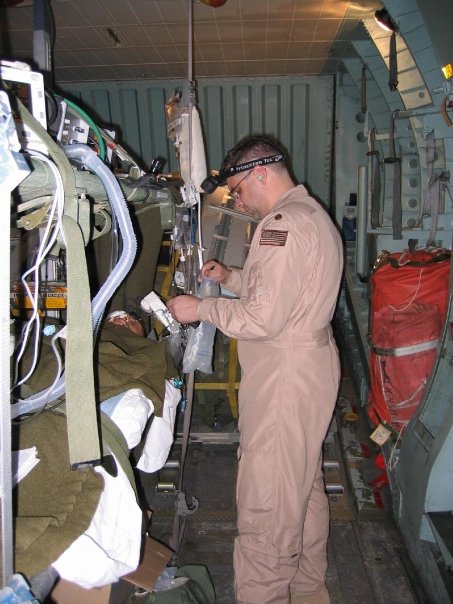
I was deployed as a critical care air evacuation physician. Our mission was to safely transport critically wounded U.S. and allied troops from the battlefields of Southwest and Central Asia to Landstuhl Regional Medical Center in Germany—and from Germany back to the United States.

Christmas Day 2003 was quiet at Ramstein Air Base. There was turkey and all the trimmings in the dining hall. A few phone calls home. A Christmas movie binge on the Armed Forces Network. My holiday doldrums were finally jolted by a brisk knock at my door early on the afternoon, the day after Christmas.

“Sir, mission briefing in Ops at 1500. Wheels up at 1800. You’re going to Baghdad.”

It would be my first time into a combat zone.

Our team was dispatched to pick up three critically injured Polish soldiers—truck bomb blast injuries. As we entered Iraqi airspace in the early morning hours of December 27th, the standard cabin lights were switched off and the aircraft’s exterior navigation lights went dark. A few dim red combat lights glowed in the back of the C-141.

After a moment, a crew member yelled,

“Get ready! We’re going in! Put on your gear!”

I reached into my A-bag, I strapped my M-9 to my side, pulled out my helmet and body armor, and quickly donned both. Looking around, I noticed everyone else was wearing their helmets—but sitting on their body armor.

The back end crew member yelled,

“Sir, gotta sit on your vest! Possible small-arms fire! You don’t want to get shot in the ass!”

I immediately took off the vest and sat on it and strapped in tight.

Everyone was seated except two crew members, who stood clipped to the sides of the aircraft with straps and carabiners. Peering out the port and starboard windows, their job was to watch for ground signatures of surface-to-air threats and relay that information to the cockpit so countermeasures could be deployed quickly.

The large, lumbering C-141 began a controlled, spiraling fall from a moonless night sky—tight hairpin turns in a combat approach into Baghdad International Airport. I said a quick prayer. My heart was in my throat. It was exhilarating.

After several gut-wrenching turns, the crew member at the starboard window began shouting animatedly into his headset. The pilot released countermeasures. A loud pop, followed by a distant boom and a flash—and moments later we were taxiing on the runway.

The poor starboard crew member had wet his flight suit. Or maybe his Camelbak had leaked. Either way, it had been close call.

While taxiing, we put our body armor on the correct way. We felt ready. Tense. Prepared.

A Humvee buzzed up alongside the aircraft as we rolled to a stop. Our welcoming party—a physician and a nurse—boarded to brief us on our patients. They were wearing shorts, shower shoes, and T-shirts.

It looked like a scene straight out of MASH.

I smiled, took a deep breath, and relaxed. 

** the picture above is from the trip out of Baghdad with our patients. Fortunately, it was uneventful.