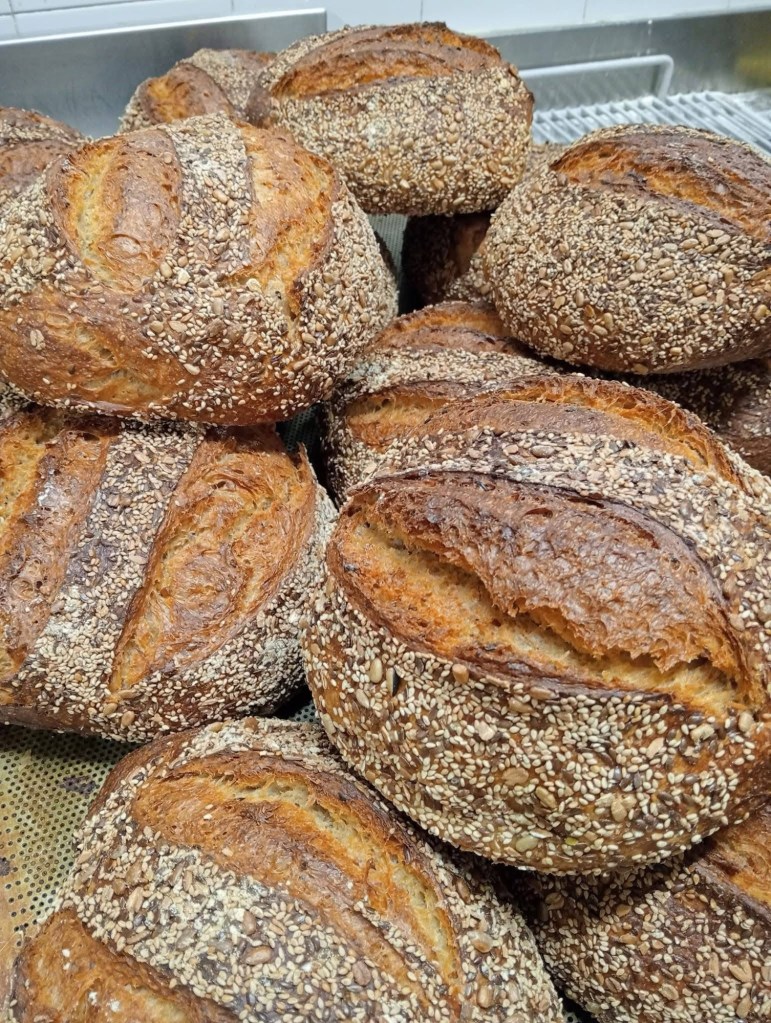
West along the Mountain Highway toward Polcenigo, there was a little bakery—Panificio Benedet—at the Coltura turnoff, tucked up into the mountain slope. It was one of our favorite places to visit when we were stationed at Aviano Air Base in northern Italy.
Every Tuesday was cereali day—the day the fornaia (baker and proprietor) baked her outstanding pane integrale ai cereali (whole-wheat multigrain bread), or, as we called it in shorthand, pane cereali (PAH-nay cheh-reh-AH-lee). It was absolutely delicious. I’m not sure what set it apart: the wild yeast native to the mountain slopes? Alpine air? Snowmelt water? Stone-ground local grains? Or maybe just a nonna’s special touch. I don’t know. But it was special—one of those delights you don’t fully appreciate until you can’t have it anymore.
A few years after we moved back to the States, I had some loose ends to tie up in Italy and made a quick trip back. By sheer good fortune, my flight home from Venice to the U.S. was on a Tuesday afternoon. So I stopped by the little bakery as soon as she opened her doors that morning…
“Buongiorno, signora. Pane ai cereali, per favore.”
(Good morning, ma’am. Multigrain bread, please.)
“Quanti pani vuoi?”
(How many loaves would you like?)
“Quanti pani sono?”
(How many loaves do you have?)
“Undici.”
(Eleven.)
“Tutti.”
(All of them.)
“Tutti???”
“Sì.”
Eyes rolling, she exclaimed, “Mamma mia!” She looked at me as if I had just proposed committing some grievous sin or maybe just using Greek olive oil on my pasta— the horror!
“Americani!”
(Americans!)
Pausing briefly, sizing me up some more, she finally relented and in no time, I was motoring down the autostrada toward Venice Marco Polo Airport in my tiny rented Fiat, two large paper bags stuffed with the finest bread on the planet riding shotgun.
Boarding the plane, I stashed the loaves in the overhead bin, and the wonderful aroma of yeasted bread and a touch of an alpine Italian Tuesday morning wafted through the cabin. My fellow passengers turned their heads and noses toward the amazing scent in almost cartoon caricature form, in vain hope that the smells portended an upcoming in-flight meal. I’m not sure whether it was heaven or hell for them. Actually, looking back, it was pretty cruel.
Recently, I’ve picked up a new hobby: sourdough artisan bread baking. And I think I’ve finally captured—if not the exact loaf, then at least the essence—of my favorite Italian fornaia. I may not have mountain air, snowmelt water, or a nonna’s special touch, but somehow the memories come flooding back as I sample my latest creation. The first bite was like a postcard I could taste.
“Mamma mia—and pass the olive oil.”
 Dash Stories
To my Nephew, you’ll have to bring some to me! They look so good!!!
LikeLike
Mama Mia! Indeed! Would love to have the recipe you’ve come up with. That my favorite pane, too! Allora….
LikeLike
Hi Dr. Sensintaffar,
I’m in a deep-dive Bible chapter study and was searching for civilization details on the Tower of Babel. I found you via a 5-year-old FB comment on Rev. Shane’s Walk through the Bible Study of all things. One of my sisters in Christ mentioned that the people wanted God to come down to them, which is something you commented, too. I wondered if you were still active on FB (sort’ve) and I found that wonderful post about the Bronze Serpent. Then I saw the link to the pork chop (aw) and read a few more posts here. I just wanted to leave a comment that you are a wonderful storyteller. Your site is bookmarked and I look forward to reading more of your stories! Thank you, sir, for your service.
Blessings,
SaraF
LikeLike
Thank you for your kind words, Sara! I’m delighted you enjoyed some of my musings. It prompted me to re-read the Bronze Serpent post—I had forgotten all about it. It was a nice refresher. I could not find the Tower of Babel post but I do remember doing a deep dive study on the Tower several years ago. We (via sermons I’ve heard in the past) have the whole thing exactly backwards. The Tower of Babel wasn’t to permit His people to ascend to Him but rather for God to descend to us. And that has been the pattern from the beginning. God came after Adam in the Garden after Adam’s disobedience. It wasn’t a contrite Adam coming to God. Yahweh first approached a polytheist man by the name of Abram in Ur, not the other way around. He went after Saul on the Road to Damascus as Saul in blind rage pursued and persecuted Jesus’ followers. Jesus took the initiative and called His disciples—“Come and follow Me”— rather than the usual pattern at the time of prospective disciples entreating the favor of the rabbi to accept them into the rabbi’s circle. Jesus came down to us, humbling Himself to the point of death on a cross (Philippians 2:6-8). God’s love aggressively pursues us, not the other way around. That is the message of the Tower of Babel. It’s a message of Grace.
God Bless you Sara!
Lowell
LikeLike